The basics
What is gum disease? From gingivitis to periodontitis
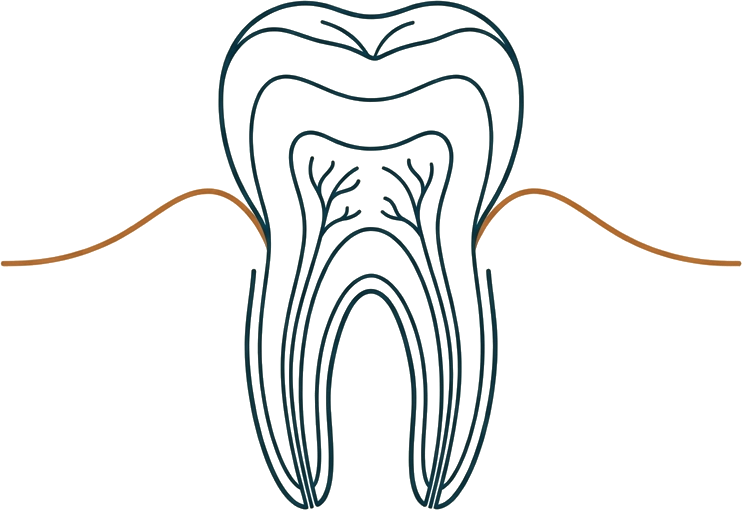
Gum disease begins as gingivitis (inflammation where the gums meet the teeth) and can progress to periodontitis, where the tissue and bone supporting the teeth break down. Understanding the stages is the first step to catching it early.
NIDCR/NIH · StatPearls
Prevalence
How common is it? About 42% of adults over 30
By the CDC's own measurement, about 42% of American adults over 30 have some form of gum disease; for adults 65 and older, it's about 60%. That makes it one of the most common chronic conditions in the country.
CDC NHANES · Eke et al.
Early warning
The silent disease: why early gum disease goes unnoticed
Early gum disease is essentially painless: there's usually no toothache to warn you, so the signs get ignored until the disease is advanced. Knowing what to look for matters precisely because your mouth won't tell you.
StatPearls/NIH · NIDCR
Signs & causes
Why do gums bleed? More than brushing too hard
Bleeding gums are often one of the earliest signs of gum disease, though technique, medications, and pregnancy can also play a role. With consistent daily cleaning between the teeth, the bleeding usually fades within about a week.
ADA · NIDCR/NIH
What's at stake
Gum disease and tooth loss: what the research shows
Periodontitis breaks down the bone and tissue that anchor teeth, which is why it's a leading cause of tooth loss in adults. We also look at a five-year NIH-funded study of older adults that linked daily flossing with keeping more teeth: an association, not a guarantee.
NIDCR/CDC · Marchesan J Dent Res 2020
The good news
Can gingivitis be reversed?
Gingivitis, the earliest stage, is the one dentists generally consider reversible with consistent daily care and professional cleaning. The strongest clinical reviews find that cleaning between the teeth reduces gum inflammation; the certainty is modest, and we explain exactly what that means.
NIDCR/NIH · Cochrane CD012018
Risk factors
Who is at higher risk for gum disease?
Smoking and diabetes are two of the clearest risk factors, and prevalence climbs with age: about 60% of adults 65 and older have gum disease. But "lower risk" doesn't mean no risk, and we walk through that nuance honestly.
CDC · NIDCR/NIH
Treatment
Treatment options, explained in plain language
From professional deep cleaning (scaling and root planing) to periodontal surgery for advanced cases, treatment depends on how far the disease has progressed. A plain-language walk-through of what each option involves and what to ask your dentist.
NIDCR/NIH